





Programme
CLIDE is a two-year international Master's programme (120 ECTS), designed to prepare future leaders for managing organisations, teams, and projects in culturally diverse and digitally transformed environments.
Delivered entirely in English by an international consortium of five universities, the programme combines academic excellence, international mobility, practical experience, and applied research. Students develop advanced competencies in leadership, intercultural communication, digital transformation, innovation, and organisational development.
Programme at a Glance
- Degree: Master's Degree
- Duration: 2 years (4 semesters)
- Credits: 120 ECTS
- Language of Instruction: English
- Mobility: Multiple countries and partner universities
- Professional Tracks: 2
- Joint integration week and Summer School: Mandatory
- Internship: Mandatory
- Master's Thesis: Mandatory
- Qualification Level: EQF Level 7
- Learning outcomes
- Syllabuses (2026)
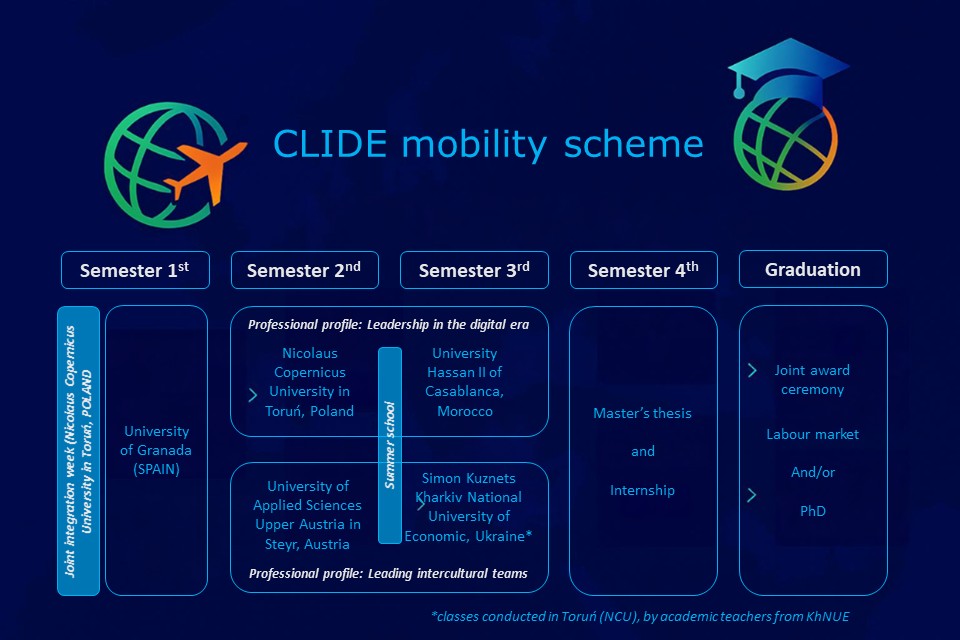
Programme Structure
The programme consists of four semesters that progressively build knowledge, skills, and professional competencies in leadership and management.
Semester 1 (from 1st October to the end of January)
Common Foundation
University of Granada (Spain)
All students begin their CLIDE journey together in Granada, where they acquire a shared academic foundation in leadership, management, communication, innovation, and sustainability.
Core themes include:
- Leadership Principles
- Communication Skills
- Strategic Management for Multinational Companies
- Managerial Ethics and Sustainability
- Creativity and Innovation for Leadership
This semester establishes a common understanding of contemporary leadership challenges and prepares students for further specialisation.
Choose Your Professional Pathway. Applicants select their pathway during the admission process.
Path A
Leading Intercultural Teams. Designed for future leaders who wish to manage multicultural teams, foster collaboration across cultures, and support organisational development in international environments.
University of Applied Sciences Upper Austria (Austria)
Key topics include:
- Distributed Intercultural Team Communication
- Inclusive Leadership
- International Human Resource Management
- Leadership of Diverse Teams
Semester 3 (from 1st September to the end of January)
Simon Kuznets Kharkiv National University of Economics
(Currently delivered at Nicolaus Copernicus University in Toruń)
Key topics include:
- Leading Across Borders and Cultures
- Multicultural Team Building
- Conflict Resolution
- Analytical Tools for Leaders
Leadership in the Digital Era
Designed for future professionals who want to lead organisations through digital transformation, innovation, and technological change.
Nicolaus Copernicus University (Poland)
Key topics include:
- Digital Literacy Development for Leaders
- Digital Business Models
- Digital Image and Personal Branding
- Organisational Digital Transformation
Hassan II University of Casablanca (Morocco)
Key topics include:
- Digital Entrepreneurship
- Digital Tools for Project Management
- Innovation Management
- International Business Development
Summer School
Between the second and third semesters, all students participate in a joint international Summer School.
The Summer School provides:
- Entrepreneurship workshops
- Research seminars
- Thesis proposal presentations
- Meetings with business representatives
- Networking opportunities with students and academics from all partner universities
Internship & Master's Thesis
Semester 4
Nicolaus Copernicus University (Poland)
The final semester combines:
Master's Thesis (18 ECTS)
Students conduct independent research addressing real-world challenges related to leadership, digital transformation, intercultural management, or organisational development.
Professional Internship (12 ECTS)
Students complete a supervised internship in an organisation relevant to their professional interests and future career plans.
Internships are jointly supervised by:
- an academic mentor,
- and a professional supervisor from the host organisation.
Learning Approach
CLIDE combines academic rigour with practical experience through:
- Interactive lectures
- Case studies
- Group projects
- Simulations
- Industry workshops
- Guest lectures
- Study visits
- Team-based learning
- Research projects
Students work on authentic organisational challenges and develop solutions relevant to contemporary international environments.
What Will You Learn?
Upon graduation, students will be able to:
- Lead Across Cultures
- Manage multicultural and geographically distributed teams while fostering inclusion and collaboration.
- Drive Digital Transformation
- Use digital technologies creatively to support innovation and organisational change.
- Solve Complex Challenges
- Apply analytical and research methods to address management problems in international environments.
- Communicate Effectively
- Engage with stakeholders across cultures and communicate professionally in English.
- Act Responsibly
- Demonstrate ethical leadership, respect for diversity, and commitment to sustainable organisational development.
Graduate Competencies
- CLIDE graduates combine:
- Leadership Skills
- Intercultural Competence
- Digital Transformation Expertise
- International Experience
- Research and Analytical Skills
- Project Management Competencies
- Professional Work Experience